Views: 0 Author: Site Editor Publish Time: 2026-03-15 Origin: Site
Buying an Inline Flexo Printing Machine is not like buying a single-purpose piece of equipment. An inline flexo line becomes the center of your production flow: printing, drying, web handling, and often inline finishing like varnish, lamination, die cutting, slitting, or rewinding. When the machine is well matched to your job mix, it improves throughput and stability. When it is mismatched—too narrow, too slow, or configured with the wrong color and drying system—it creates bottlenecks and waste that are hard to “fix later” without expensive upgrades.
From our perspective at Wenzhou Henghao Machinery Co., Ltd., most purchasing mistakes come from comparing headline numbers without connecting them to real production behavior. Buyers see a maximum speed, a maximum width, and a number of colors, but they do not always ask the more important questions: What is my real printable width after edge trim? What speed can I sustain on my actual substrates? How many colors do I truly need per job, including spot colors and varnish? What drying capacity is required for the inks I plan to run? This guide is designed to answer those questions in a practical way. We’ll explain how to choose print width, speed, and color stations—and how to make sure the whole inline flexo line matches your material types, order structure, and finishing requirements.
Before you choose print width or speed, list your real products:
labels (paper, PE/PP/PET films)
packaging film (BOPP, PE, laminated structures)
paper bags or wrapping papers
shrink sleeves (where applicable to flexo processes)
multi-layer label constructions
coated vs uncoated paper
Also list:
typical job length (short runs vs long runs)
typical design complexity (2 colors vs 6 colors + varnish)
required finishing steps (lamination, cold foil, die cut, slitting, inspection)
“Print width” is often misunderstood. The machine’s maximum web width is not the same as your usable print width.
You typically need allowance for:
web guiding and side movement
edge trim
registration tolerance
slitting layout
waste margin for stability
So the usable print width is usually less than the maximum web width.
A practical method:
Identify your most common label/film widths
Identify your widest repeatable job requirement
Add margin for trim and stable web handling
Select the machine width that covers your present needs plus moderate growth
Your Job Profile | Recommended Width Logic | Why |
Mostly narrow labels | choose width that supports multi-up | improves efficiency |
Mixed label + mid-width packaging | choose a flexible mid-range width | reduces job limitations |
Large packaging webs | choose width based on max product + margin | avoids rework and restrictions |
Future expansion expected | choose a width step above current max | avoids early machine replacement |
Oversizing too much can also increase costs and make setup more demanding, so “right-sized with buffer” is usually the best decision.
Every flexo machine has a published maximum speed. But buyers should evaluate sustainable production speed based on real conditions.
high ink coverage and heavier drying load
film substrates that are sensitive to heat
thin webs that require gentler tension
tight registration requirements
frequent job changeovers
inline die cutting or slitting limits
The machine’s true productivity depends on:
stable web handling
drying capacity
operator workflow
setup time and repeatability
Instead of asking: “What is the max speed?”
Ask: “What speed can I run consistently on my top 10 products with stable quality?”
Production Condition | Speed Impact | What to Prioritize |
Heavy ink coverage | speed may drop due to drying | stronger drying system |
Thin film | speed limited by tension stability | better web control |
Many short runs | speed less important than changeover time | automation + repeat settings |
Inline finishing | speed limited by downstream unit | line balancing |
If your business is short runs, fast setup and stable registration often matter more than peak speed.
Color stations are one of the most expensive decisions because they affect machine length, cost, and complexity. The best number depends on your actual printing requirements.
basic packaging or simple labels: 1–4 colors
branded labels with spot colors: 4–6 colors
high design variety: 6–8 colors (sometimes more depending on workflow)
plus varnish, primer, or special coating needs
Many products require:
varnish (gloss or matte)
primer for film adhesion
special coating for protection or friction control
These are not always “colors” in the design sense, but they still require stations.
Product Requirement | Typical Station Need | Why It Matters |
Simple 1–3 color labels | 4 colors often enough | allows flexibility + spot colors |
Full design + spot colors | 6 colors common | handles branding variation |
Varnish needed | add coating station or plan space | protects print and improves finish |
Film printing | may need primer station | improves ink adhesion |
A common buyer regret is purchasing “just enough” colors and then realizing every job needs an extra spot color or varnish station.
Inline flexo print quality depends on mechanical stability and process control. In buying decisions, consider:
registration stability and servo control
anilox and plate cylinder change convenience
web guiding accuracy
tension control and rewind stability
vibration control and frame rigidity
A machine that holds registration well at a moderate speed can outperform a faster machine that struggles with stability.
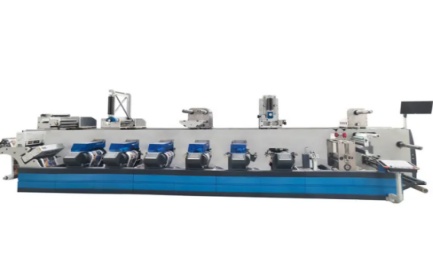
Drying capacity often determines real speed more than the motor power does.
Typical drying options include:
hot air drying
IR drying (in some configurations)
UV drying for UV inks (with proper safety and curing design)
ink type (water-based, solvent-based, UV)
substrate type (paper vs film)
ink coverage and layer thickness
desired speed and quality level
Ink/Substrate | Drying Focus | Risk if Under-Sized |
Water-based on paper | airflow and evaporation | set-off and smearing |
Solvent-based on film | safe ventilation and control | odor and incomplete dry |
UV inks | curing energy and uniformity | poor cure and rub issues |
When buyers want higher output, upgrading drying capability often delivers more real benefit than chasing higher max speed.
An Inline Flexo Printing Machine is often purchased because it can combine processes. But this also means your finishing needs should influence the base machine selection.
Common inline modules include:
laminating unit
cold foil unit
varnish/coating unit
die cutting unit
slitting and rewinding
inspection and defect detection
A practical rule:
If most of your jobs require die cutting, your line should be designed around stable die cutting performance—not treated as an afterthought.
For many converters, productivity is limited more by changeovers than by printing speed.
Consider features that improve workflow:
quick-change anilox and sleeves
preset job memory for tension and registration
easier cleaning access
stable web threading design
automated registration adjustment
Your Production Style | Highest ROI Feature |
Short runs, many SKUs | faster changeover + automation |
Long runs | stable continuous running |
Mixed jobs | flexible configuration and repeatability |
A machine that reduces downtime often creates stronger profit than one with a higher max speed that is rarely reached.
Choosing the right Inline Flexo Printing Machine is about matching the machine’s print width, speed, and color stations to your real production needs—not just comparing maximum numbers. A practical buying decision considers usable width after trim, sustainable speed under your ink and substrate conditions, and color station planning that includes coatings and primers. When drying capacity, web handling, and inline finishing modules are aligned with your job mix, you get a line that runs smoother, changes over faster, and delivers stable quality across products.
At Wenzhou Henghao Machinery Co., Ltd., we support converters and packaging producers with inline flexo solutions designed around real production logic—width planning, stable web control, appropriate drying systems, and color/finishing configurations that fit your market. If you want to discuss your product mix and choose an inline flexo printing machine configuration that matches your growth plan, you are welcome to contact Wenzhou Henghao Machinery Co., Ltd. to learn more.
Choose based on your maximum product width plus allowance for trim, guiding, and registration, and add a reasonable buffer for future growth.
Not always. Sustainable speed depends on drying capacity, substrate behavior, registration requirements, and changeover frequency.
It depends on your job designs. Plan for real color needs plus varnish or primer requirements, not only the visible design colors.
Drying capacity often limits real production speed and prevents issues like smearing, set-off, or poor curing, especially with high coverage or film substrates.