Views: 0 Author: Site Editor Publish Time: 2026-03-13 Origin: Site
If you’re exploring a new press for labels or flexible packaging, the term inline flexo printing machine will appear quickly—often alongside questions like “Is it better than CI flexo?” “Can it run multiple processes in one pass?” or “Will it fit our short-run jobs without killing changeover time?” We hear these questions regularly, and they make sense. Flexo equipment is not a small purchase, and the wrong configuration can limit your product range, increase waste, or create bottlenecks at converting. At the same time, the right inline setup can simplify production, reduce handling, and help you move from a “print-only workflow” to a true one-pass converting line.
From our perspective as a machinery supplier, an inline flexo press is best understood not only as a printing unit, but as a production platform. The key value is in the word “inline”: printing units can be combined with drying/curing, lamination, varnishing, die-cutting, slitting, sheeting, and rewinding—depending on your product. That integrated capability is why inline flexo presses are widely used in label production, paper and film packaging, and many types of roll-to-roll converting. This article explains what an inline flexo printing machine is, how it works, what it’s used for, and what buyers should evaluate before selecting a configuration.
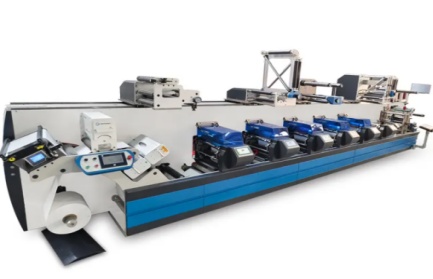
An inline flexo printing machine is a flexographic printing press where the web (paper, film, foil, or laminate) travels through multiple print stations arranged in a line. Each station prints one color (or one coating/varnish), and the material continues directly to the next station without stopping.
“Inline” also commonly means the press can be built as a modular line. In addition to print stations, it can include inline units such as:
corona treatment (for film surface energy improvement)
drying systems (hot air, IR, UV, depending on ink/coating)
varnish or coating stations
lamination modules (for certain packaging structures)
cold foil (in some configurations)
rotary die-cutting (very common for labels)
slitting and rewinding (for finished rolls)
So, when buyers ask “what is it used for,” the most accurate answer is: it’s used for printing and converting in one continuous pass, with the final output tailored to your product type.
Flexographic printing uses:
a flexible printing plate (mounted on a plate cylinder)
an anilox roller (meters ink volume precisely)
an ink system (water-based, solvent-based, or UV ink depending on application)
an impression cylinder (presses substrate against the plate)
The anilox roller picks up a controlled ink film, transfers it to the plate, and the plate transfers the image to the substrate. Because it’s a rotary process, flexo is highly suitable for continuous roll-to-roll production.
In an inline press, each station repeats that same process for another color or coating layer. Registration control (keeping colors aligned) is managed by mechanical design and control systems, and increasingly by servo-driven systems in modern configurations.
Flexo presses are commonly grouped into three families: inline, CI (central impression), and stack. Each has advantages. The best choice depends on what you print and how you convert it.
Press type | Basic structure | Typical strengths | Common applications |
Inline flexo | stations in a line | modular converting, one-pass workflow | labels, paper packaging, films, multi-process lines |
CI flexo | stations around one central drum | excellent registration for thin films | flexible packaging, high-speed film printing |
Stack flexo | stations stacked vertically | versatile, accessible stations | paper, bags, some packaging products |
An inline flexo printing machine is often chosen when the buyer wants printing plus finishing in a single line—especially for label production and packaging formats that benefit from inline die-cutting and rewinding.
This is one of the most common uses. Inline flexo is widely used for:
pressure-sensitive labels
logistics and barcode labels
industrial identification labels
food and beverage labels (depending on materials and compliance needs)
pharmaceutical and healthcare labels (depending on standards)
In label workflows, the inline advantage is strong because printing can be combined with varnish, lamination, cold foil (optional), die-cutting, matrix stripping, slitting, and rewinding—all in one pass.
Inline flexo is commonly used for:
paper bags and wrapping paper
paper packaging webs
paper-based laminates (depending on structure and process design)
general paper printing where roll-to-roll efficiency matters
Paper is generally stable on press, and inline configurations can support coating, varnish, and finishing steps that add value.
Inline flexo can also be used for films, especially when the product structure and speed targets match inline capabilities. Typical uses include:
certain packaging film prints
surface printing before lamination
simple flexible packaging formats (depending on thickness and registration needs)
For very thin, high-speed flexible packaging with extremely tight registration demands, CI flexo is often considered. But inline remains strong where the buyer values modular converting and mixed product runs.
An inline flexo press can be used not only for color graphics, but also for functional coatings such as:
overprint varnish (gloss or matte)
primer layers
adhesion-promoting coatings
protective coatings for scuff resistance (depending on chemistry)
This is a major advantage for packaging and label products where durability and surface performance matter.
Many customers want to reduce handling steps. Inline flexo can integrate multiple operations:
print → dry/UV cure → varnish → die-cut → slit → rewind
or
print → dry → lamination → chill → slit → rewind
Not every project needs every module, but the inline architecture makes it easier to add the processes you actually use.
When printing and converting happen in separate steps, every step adds:
handling time
alignment risk
WIP inventory
additional operators
more potential scrap during restart
Inline processing can reduce these losses by finishing in one pass.
A stable web path through printing and converting reduces variability. It’s often easier to maintain consistent tension and registration when operations are integrated rather than split across machines.
Inline presses are often scalable by:
adding more color stations
adding a coating station
upgrading drying/curing capacity
adding a die-cut module
improving control systems (servo upgrades, register control)
That scalability is valuable for converters who expect product mix changes over time.
While exact configurations differ, most inline flexo machines include:
Unwind unit
Holds parent rolls and stabilizes feeding. Options can include splicing, tension control, and edge guiding.
Web guiding and tension control
Critical for stable printing and converting. Good tension control reduces wrinkles, misregister, and die-cut instability.
Print stations
Each station typically includes anilox, plate cylinder, ink system, impression control, and register adjustment.
Drying or curing system
Hot air or IR for water/solvent systems, UV for UV inks/coatings. Drying capacity is a major performance limiter if undersized.
Optional modules
Varnish, lamination, cold foil, die-cutting, sheeting, slitting—configured based on product needs.
Rewind unit
Finished rolls are rewound with controlled tension. For labels, stable rewinding affects dispensing performance and customer satisfaction.
An inline flexo printing machine is best understood as a modular, one-pass roll-to-roll production platform. It prints through multiple stations arranged in a line and can integrate finishing processes such as coating, die-cutting, slitting, and rewinding—making it especially valuable for label converting and many packaging workflows. The real advantage is not only print quality, but production efficiency: fewer handoffs, better process control, and a faster path from raw roll to finished product. The right configuration depends on your substrate range, ink system, width, speed goals, number of colors, and the finishing steps your customers actually need.
At Wenzhou Henghao Machinery Co., Ltd., we work with converters and manufacturers to match inline flexo configurations to real production targets—balancing capability, stability, and operating simplicity. If you’re evaluating an inline flexo printing machine for labels or packaging, you’re welcome to contact us to discuss your material types, required colors, target width, and finishing workflow so we can share practical recommendations and suitable options.
An inline flexo printing machine is used for roll-to-roll printing and converting such as labels, paper packaging, film printing, varnish coating, and one-pass die-cut and rewinding workflows.
It prints through multiple flexo stations arranged in a line. Each station applies one color or coating, then the web moves forward through drying/curing and optional finishing modules before rewinding.
Not always. CI flexo is often chosen for very thin films and high-speed flexible packaging with extremely tight registration demands, while inline flexo is often chosen for modular converting and mixed product runs.
Confirm your substrate range, web width, ink type, drying/curing needs, number of colors, target speed, and required inline finishing such as die-cutting, slitting, and rewinding.